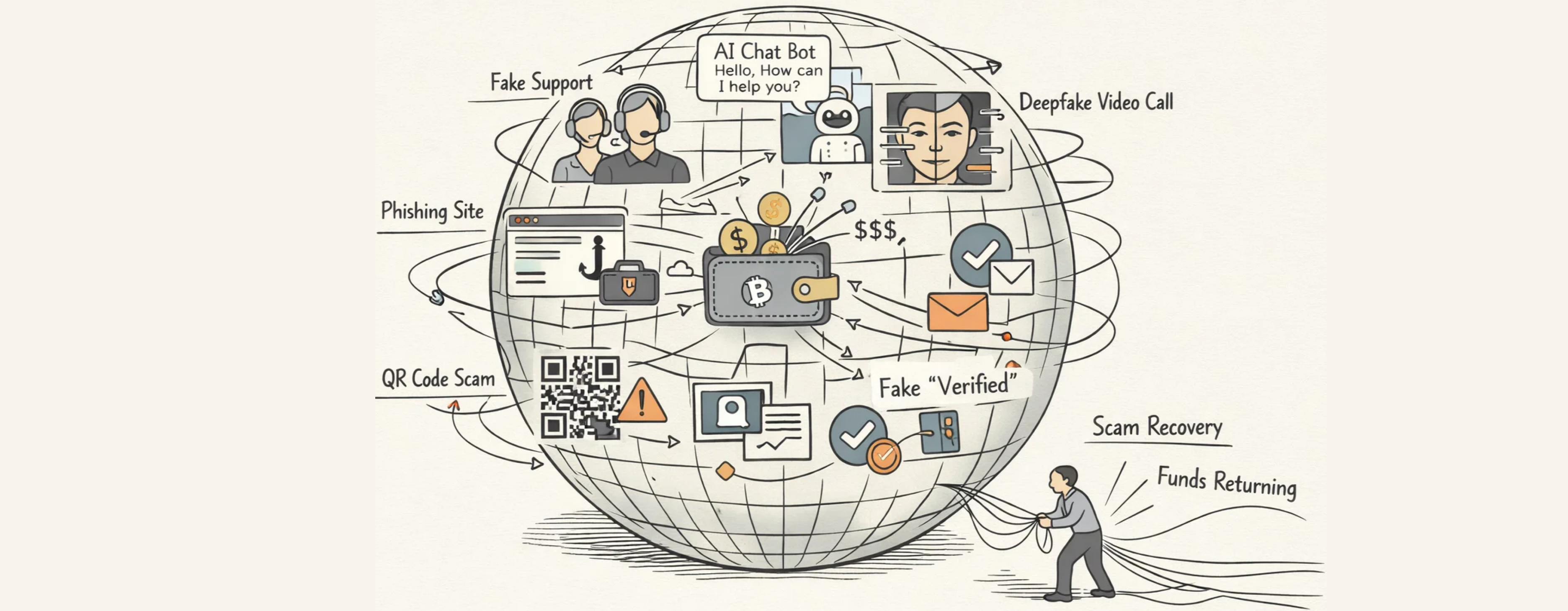


Get your money back from Digital Currency scam
Thousands of clients used our Investigation Report to retrieve their losses. Start with a free consultation

Some of the frauds we investigated












How it works

Review your case
Based on our experience, we are performing preliminary checks to assess whether your case can result in a substantial retrieval of losses.

Gather the evidence
We then gather every piece of evidence you have from your contact with the scammers along the way.

Investigation Report
We investigate your case and the people who scammed you to provide a detailed Investigation Report.

Action Plan
With our investigation Report, you'll receive a step-by-step action plan explaining how we believe you can retrieve your losses.

Expert Assistance
Our team of experts can guide you in the execution of the recommended action plan.

Get your money back
Once you successfully execute the suggested action plan, you could retrieve a substantial part, if not all, of your money.
Your money back guarantee
Retrieving your losses can be a lengthy process, and it all starts with our investigation. Therefore, we must have your trust every step of the way. So, if for any reason you are doubtful, you can ask for a full refund within 14 business days.*
*Read Terms & ConditionsWhat is digital currency?
Digital currency is a form of currency that exists only in digital or electronic form. At its core, it’s meant to be a secure and decentralized medium of exchange, often using blockchain technology to record transactions. Due to its potential for high returns, it has gained immense popularity in recent years. However, high volatility and pseudo-anonymity also make it fertile ground for sophisticated cyber fraudsters.
Three important Digital Currencies
Bitcoin (Digital Coins):
The original and most valuable digital currency, viewed as "digital gold" due to its fixed 21M supply cap and store-of-value potential. First deployed in 2009, it operates on a decentralized proof-of-work blockchain network.
Ethereum:
The second-largest cryptocurrency by market cap and the foundational engine for smart contracts and decentralized finance (DeFi). Its underlying virtual machine executes programmable transactions.
Ripple (XRP):
Engineered for high-speed cross-border settlement between banking institutions, highlighting the balance between decentralized protocols and institutional regulatory scrutiny.
Key points
- ✓Digital currencies present novel investment opportunities alongside substantial cybersecurity and counterparty risks.
- ✓Beware of unrealistic promises of rapid wealth, automated compounding, or risk-free daily interest.
- ✓Always verify destination wallet addresses, domain SSL certificates, and exchange regulatory credentials.
- ✓Never share your private keys, recovery seed phrases, or remote screen access with third parties.
Is digital currency a scam?
Cryptocurrency itself is a legitimate technological innovation, but the lack of centralized clearinghouses and irreversible transaction properties create an enticing environment for fraudsters. Here are the 7 most frequent scams targeting cryptocurrency investors:
1. Cloud Mining Scams
Fraudulent platforms solicit investment into nonexistent cloud mining farms, promising passive dividends while simply using newer deposits to pay earlier investors until the site disappears.
2. Fake Wallet & Phishing Apps
Cloned mobile wallets and malicious browser extensions designed to steal seed phrases or silently swap recipient wallet addresses in the clipboard during copy-paste actions.
3. Pump and Dump Schemes
Coordinated groups artificially inflate the price of low-liquidity altcoins using social media hype, then dump their reserves on unsuspecting retail buyers.
4. Multi-Level Pyramid Schemes
Schemes disguised as educational packages or token pre-sales that mandate recruitments of new members to earn tier-based compensation.
5. ICO & Rug Pull Exit Scams
Developers mint a new token, promote it heavily on Telegram or Twitter, lock liquidity superficially, and suddenly drain the liquidity pool once substantial capital is raised.
6. Excessive Yield & Fake Staking Scams
DeFi platforms offering unsustainable 50%–200% annual percentage yields (APY), locking funds in unverified smart contracts that include backdoors for admin withdrawal.
7. Fraudulent Exchange Platforms
Fake cryptocurrency trading platforms designed to look identical to legitimate exchanges. Users can deposit and see paper gains, but withdrawal requests result in demands for additional "clearance fees" or frozen accounts.
Fall prey to a Digital Currency scam? How you can get your money back
If you have fallen victim to a digital currency scam, remember that public blockchains are distributed ledgers where every single transaction leaves an indelible digital footprint. No transaction is entirely invisible or untraceable.
Online Reclaims employs blockchain analytics tools and intelligence databases to track stolen tokens through intermediary mixers, cross-chain bridges, and unhosted wallets directly to Know-Your-Customer (KYC) compliant off-ramps and centralized exchanges.
Have your crypto assets been stolen? Submit your transaction hashes for a preliminary forensic review.
What is Crypto Asset Recovery?
Crypto asset recovery is a multidisciplinary practice combining blockchain forensic tracing, cyber intelligence, legal document preparation, and exchange liaison. By mapping the full transaction graph from the victim's wallet to custodian deposit addresses, investigators assemble verifiable evidentiary dossiers suitable for law enforcement subpoenas and asset freezing orders.
The Role of Blockchain Technology
While the immutable nature of the blockchain prevents manual chargebacks, its radical transparency enables forensic tracking. Every block contains transaction timestamps, sender addresses, recipient addresses, and contract interactions. Our analysts use transaction graph visualization to follow the movement of illicit proceeds across complex laundering hops.
Legal Frameworks and Regulations
Regulatory scrutiny over virtual asset service providers (VASPs) has expanded under FATF Travel Rule guidelines. Regulated exchanges across the US, EU, UK, and Asia are legally obligated to freeze flagged illicit deposits and respond to verified police disclosure notices. Online Reclaims aligns forensic reports with official law enforcement and judicial standards.
A Tailored Approach
Every crypto theft involves unique technical parameters: differing chains (Bitcoin, Ethereum, Solana, TRON), smart contract interactions, and decentralized protocols. We structure an individualized recovery roadmap for every case, ensuring tailored evidence documentation that directly targets where the fraudsters cashed out.
How to avoid digital currency scams
- •Store in Hardware Wallets: For long-term holdings, use offline hardware devices (Ledger, Trezor) rather than leaving assets on exchanges.
- •Verify Smart Contract Approvals: Regularly audit and revoke unlimited token allowances using tools like Revoke.cash.
- •Verify Domain URLs: Bookmark authentic exchange URLs to prevent typo-squatting and malicious Google search ad clones.
- •Reject Unsolicited Direct Messages: Legitimate crypto support staff will never direct message you first asking for seed phrases.